Lighting
Hanging a pendant, and choosing the light
How low a pendant should hang over a table, how wide its shade should be, and what lumens and kelvin mean on a listing, set out as the conventions lighting designers use.
Over a table: 65 to 75 cm
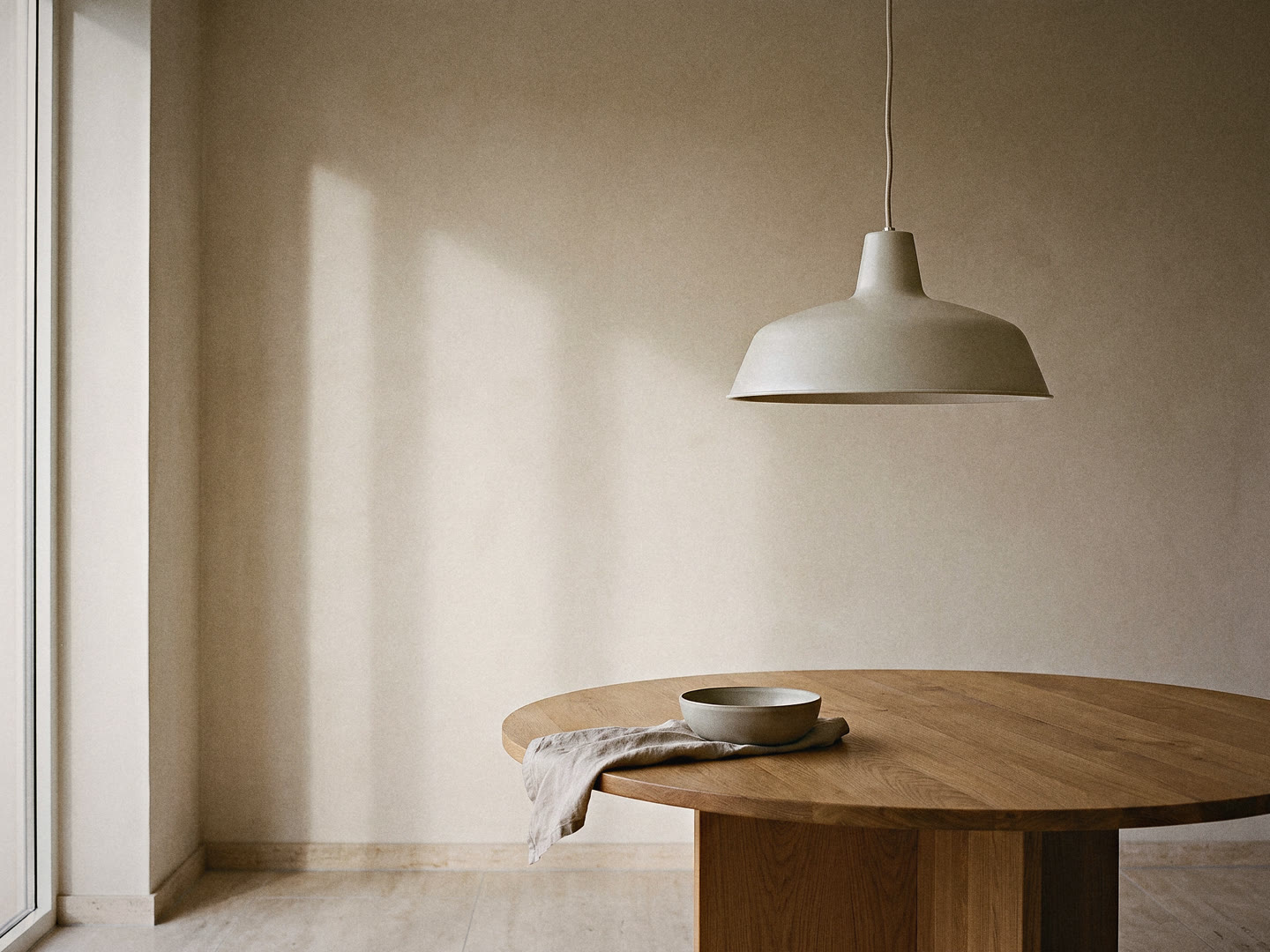
A pendant over a dining table is usually hung with the bottom of the shade 65 to 75 cm above the tabletop. At that height it lights the table, sits below the eye line of someone standing, and leaves the faces of the people seated opposite each other in view.
Hung higher, the light spreads and the glare reaches the eyes of anyone seated; the room loses the pool of light that makes a table feel like a place. Hung lower than about 60 cm, it starts to block the view across the table and gets knocked when dishes are passed.
Tall rooms can take a little more height, towards 80 cm, and an opaque shade can hang lower than an open bulb. Fix the height with someone sitting at the table, and adjust before the electrician leaves if you can.
Away from a table: 210 cm and up
Where people walk under a pendant, in a hall, a living room or over a kitchen floor, the bottom of the fitting should be at least 210 cm from the floor, so that a tall adult passes without ducking. In rooms with a standard ceiling height of 240 to 260 cm, that leaves little room for a long drop, which is why flush or close-to-ceiling fittings are common in walkways.
Over a kitchen island the convention is the same as over a table, 65 to 75 cm above the worktop, measured from the bottom of the shade. Over a bed or a side table, a hanging lamp in place of a table lamp usually sits around 50 to 60 cm above the surface.
Remember the cord. Many pendants are sold with a fixed length that can be shortened but not lengthened. The listing gives it, and it decides whether the lamp reaches the height you want from your ceiling.
Shade width and spacing
A single shade looks in proportion over a table when it is about half to two thirds of the table’s width, and it should stay at least 15 cm inside the table edge on every side, so nobody stands up into it. A table 90 cm wide therefore suits a shade of about 45 to 60 cm.
A long table takes two or three pendants better than one. Space them evenly, typically 60 to 80 cm apart between shades, and keep the outer ones well inside the ends of the table. A linear fitting, a single long bar, does the same job with one connection.
Light from a shade depends on its shape and material as much as its size. Opaque shades throw light down in a defined circle; paper, fabric and opal glass glow and light the room as well as the table.
Lumens, kelvin and colour rendering
Brightness is given in lumens. As a rough guide, about 450 lumens replaces an old 40 W bulb, 800 lumens a 60 W bulb and 1,500 lumens a 100 W bulb. A pendant over a dining table is usually comfortable at 800 to 1,500 lumens in total, ideally on a dimmer, and the maker states whether the fitting and the bulb can be dimmed.
Colour temperature is given in kelvin. Around 2,700 K is the warm white of most homes in the evening; 3,000 K is a little crisper; 4,000 K is neutral white, more suited to a desk or a kitchen worktop than a dining room. Mixing temperatures in one room tends to look accidental.
Colour rendering, given as CRI or Ra, says how faithfully a light shows colours. A value of 90 or more keeps wood, food and skin looking as they do in daylight. It is printed on most bulb packaging and on good listings.
Before you buy
Check the fitting’s socket type and maximum wattage, whether a bulb is included, the cord or drop length, the weight, and the ceiling fixing the maker supplies. A heavy fitting may need a stronger fixing than a standard ceiling rose.
Outdoors and in bathrooms, look for the fitting’s IP rating, which the maker states: it says how far the fitting is protected against dust and water. Which rating a given place needs is set by local wiring rules.
Rules on who may connect a fixed light fitting differ between European countries, and in several it is work for a qualified electrician. Plug-in floor, table and wall lamps avoid the question altogether.
In the shops
Pendants and lamps
Nothing in the shops matches today.