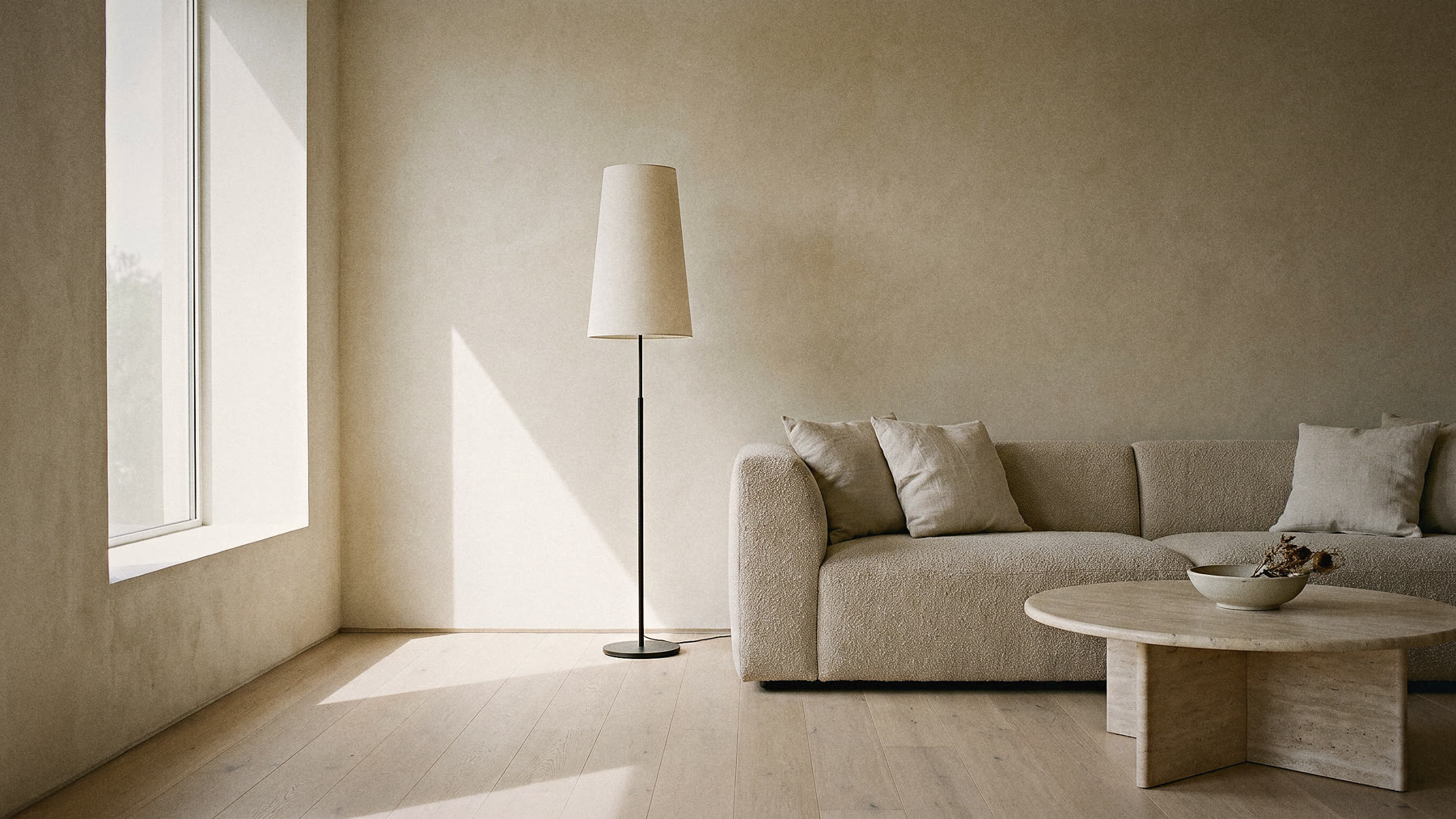
Planning
Rug sizes, room by room
The commonest mistake with a rug is buying one too small. A few plain rules, about where the furniture legs go and how much floor shows, settle the size.
Start from the furniture, not the floor
A rug ties a group of furniture together. Its size should come from that group, the sofa and chairs or the table and its chairs, rather than from the room. A rug that floats in the middle of the floor with every piece standing off it tends to look like a mat that has drifted.
Rugs are sold in a handful of standard sizes, with small variations between makers: 140 × 200, 160 × 230, 200 × 300 and 250 × 350 cm are the usual rectangles, and 200 or 250 cm the usual rounds. It is worth working out the size you need first, then finding the nearest standard size, and only then looking at colours.
Mark the size on the floor with tape, or lay out a sheet, before buying. A rug that looks generous on a listing is often smaller in the room.
The living room: front legs on
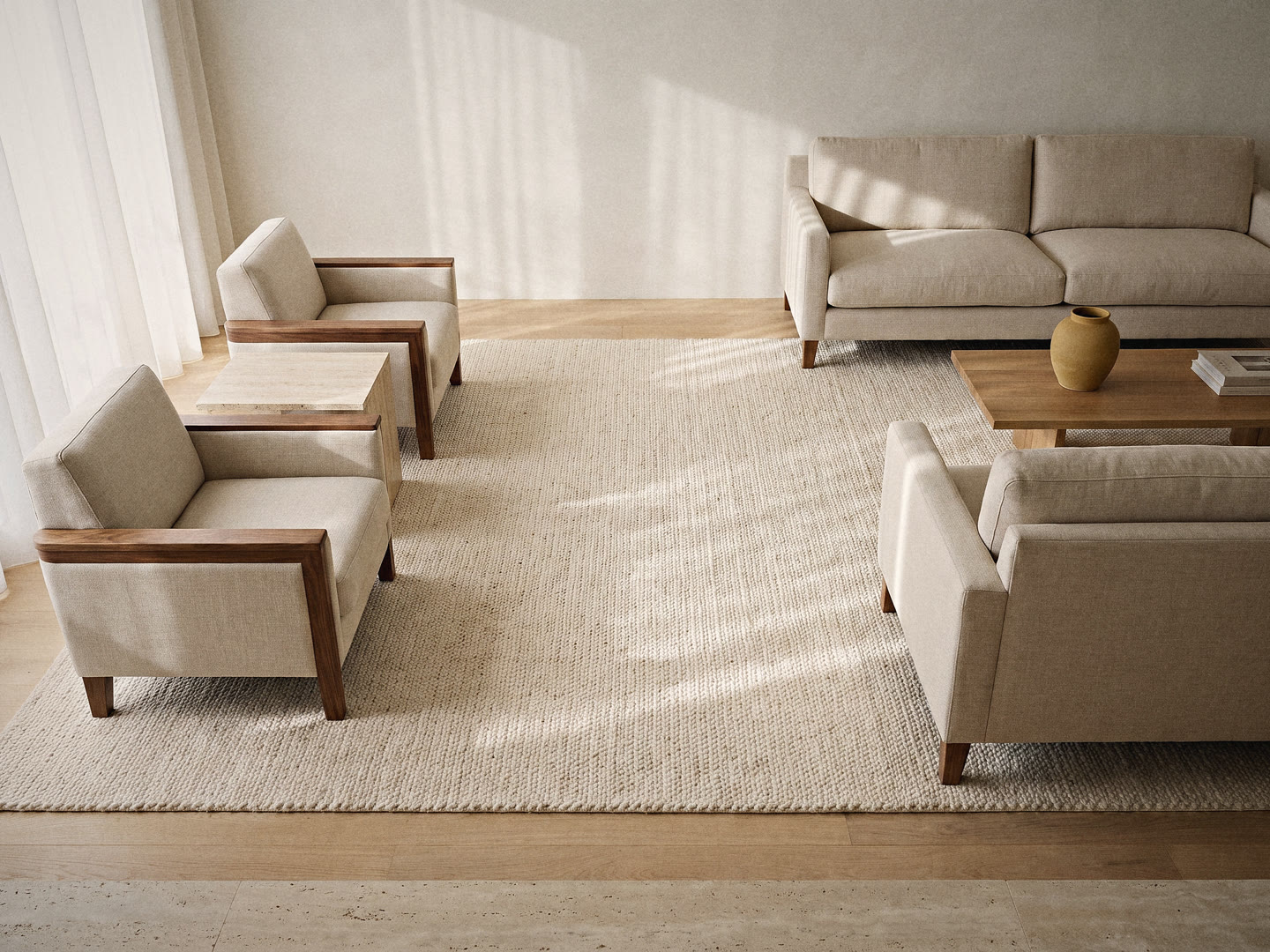
The usual rule is that the front legs of the sofa and of every armchair stand on the rug, and the back legs stand on the floor. That anchors the group without needing a rug that covers the whole room.
For a three-seat sofa of 220 cm, that suggests a rug of at least 200 × 300 cm laid lengthways along it, so that it reaches 15 to 20 cm beyond each end of the sofa. A 160 × 230 rug suits a two-seat sofa or a smaller room. If all the furniture can stand fully on the rug, so much the better: it reads as calmer still.
Leave a band of bare floor between the rug and the walls, typically 20 to 60 cm. Less than 20 cm looks like a fitted carpet that has fallen short; much more than 60 in a small room makes the rug look stranded.
The dining room: chairs stay on when pulled out
Under a dining table the rule changes. The rug should reach far enough that a chair stays on it when pulled back to sit down, otherwise its back legs catch the edge every time. That means 60 to 75 cm beyond the table edge on every side where there are chairs.
For a table of 90 × 180 cm, that gives a rug of at least 240 × 330 cm. For a round table of 120 cm, a round rug of 250 to 270 cm. These are larger than most people expect, and it is the commonest reason a dining rug disappoints.
Flat weaves and low, dense piles are easier under a table than deep ones: chairs slide on them and crumbs come out. Many households leave the floor bare under a dining table for that reason, which is a perfectly good choice.
The bedroom and the hall
Under a bed, a rug is mostly for the first step in the morning. Laid across the lower two thirds of the bed, it should reach 50 to 60 cm beyond each side. For a 160 cm bed that means about 200 × 300 cm laid crossways, or two runners of 70 to 80 cm wide, one each side.
In a hall or corridor, a runner looks right with 10 to 15 cm of floor showing along each side, and should stop short of doors so they open freely. Check the clearance under a door before buying a thick runner for a doorway.
In every room, put a rug pad underneath unless the maker says otherwise. It keeps the rug from creeping, protects the floor, and on a hard floor it is often what keeps someone from slipping.
What a listing tells you
Beyond size, the useful facts on a rug listing are the fibre, the construction and the pile height. Wool is hard-wearing and resists soiling; cotton and jute are cheaper and less resilient; synthetic fibres vary widely. Hand-knotted, hand-tufted, flat-woven and machine-made rugs differ in price, weight and how long they last.
Pile height affects more than feel. Over about 2 cm, a rug can catch a door, unsettle a chair and hold dirt. Under 1 cm, it is easy to clean and to sit chairs on.
Cleaning advice and any claims about wear, colourfastness or suitability for underfloor heating are the maker’s to state. Read them on the listing, and the shop’s terms for returns on large rugs, which are often stricter than for smaller goods.
In the shops
Rugs
Nothing in the shops matches today.